August is when air conditioning systems across the country are running at their absolute peak. The compressor has been cycling on and off for months. Dust has settled deep into coils and filters. Refrigerant lines are sweating under sustained heat. And your energy bill is already higher than it was in June.
The problem is that most homeowners wait until something breaks before they touch their AC unit. By then, a $15 filter replacement has turned into a $400 service call, and the house stays warm for hours while you wait for a technician.
According to USA Today, American homeowners are expected to pay up to 10.5% more in electricity costs during the summer of 2026, driven by longer and hotter heat waves that put extra strain on HVAC systems. A dirty or neglected air conditioner only makes that number worse.
Seven specific maintenance tasks cover the most common causes of mid-summer AC inefficiency. You can do them all yourself, with no special tools, in under two hours. Together they can reduce your cooling costs by 15 to 25 percent.
Why spring cleaning is not enough
Most AC maintenance guides say to service your system in spring. Fair enough. But four months of continuous use degrade performance whether you prepped the system or not. Filters that were clean in April are clogged by August. Condenser coils that were clear in May are coated with pollen, grass clippings, and cottonwood fluff.
A study on air conditioning energy consumption found that a dirty air filter alone can increase energy usage by 15 to 25 percent. One homeowner reported a 20 percent jump in their monthly electricity bill after neglecting to change the filter for six months. That is the kind of creeping cost that shows up on your bill as a slow increase you attribute to “hot weather” when the real culprit is a system fighting to push air through a filthy barrier.
Mid-summer maintenance also catches problems before they become emergencies. A condensate drain line that is partially clogged in August will overflow completely during the first September heat spike. A bent condenser fin that reduces airflow by 10 percent now will reduce it by 30 percent once the next heat wave hits. These are small fixes when you catch them early and expensive repairs when you do not.
The tasks below go from easiest to most involved. First three: fifteen minutes. Full list: about ninety minutes with a break in the middle.
Task 1: Replace or Inspect Your Air Filter
The highest-impact task you can do, and it takes five minutes. Your air filter lives behind a return vent grille or inside the air handler unit. Pull it out and hold it up to a light. If you cannot see light through the filter media, replace it.
Peak summer means peak demand on filters. Most need replacement every 30 days. Pets, nearby construction, or household allergies? Cut that to 20 days. A standard 1-inch MERV 8 filter runs $3 to $8 at any hardware store.
When you install the new filter, check the airflow arrow printed on the frame. It should point toward the blower motor, which is usually toward the center of the unit. Installing it backward restricts airflow and defeats the purpose entirely.
If your system uses a 4-inch or 5-inch media filter, those last longer, typically 3 to 6 months. But “longer” does not mean “forever.” Pull it out and look at it. If it is gray or brown instead of white, replace it regardless of what the calendar says.
While you have the filter out, peek into the slot. Dust and debris collect on the edges where the filter frame meets the housing. Wipe that out with a damp cloth before sliding the new filter in. That gunk gets pulled into the system every time the blower runs.
Task 2: Clear the area around your outdoor unit
Your outdoor condenser unit pulls air in through the sides and pushes hot air out the top. Anything blocking the intake side makes the compressor work harder and reduces cooling efficiency.
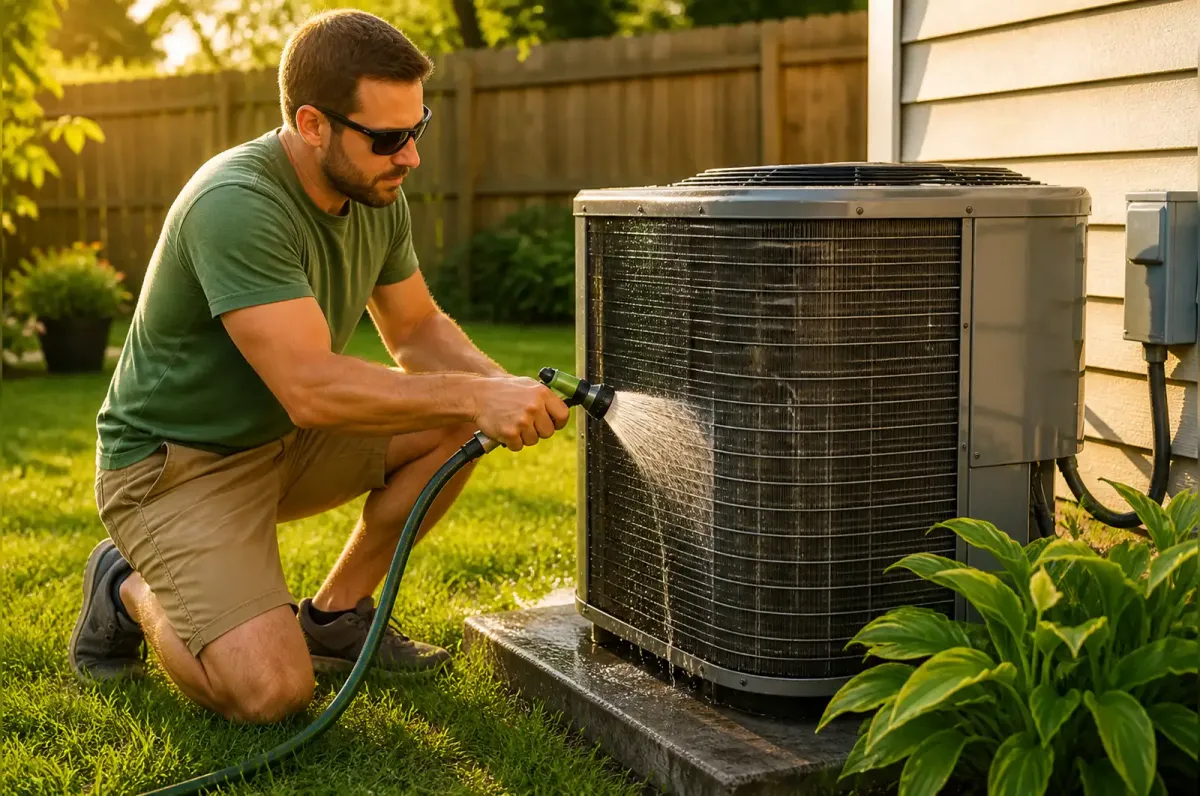
Walk around your outdoor unit and look for obstructions. August brings overgrown shrubs, fallen branches, grass clippings from recent mowing, and outdoor furniture that drifted too close. You need at least two feet of clear space on all sides.
Use a garden hose with moderate pressure to rinse debris off the condenser fins. Do not use a pressure washer. The aluminum fins on the condenser coil are thin and bend easily under high pressure. Remove the nozzle from your hose to get a moderate, wide spray pattern. Rinse from the inside out if you can access the unit, pushing debris away from the coil rather than deeper into it.
Check the base for standing water. A little condensation is normal. Pooled water, though, can mean a clogged condensate drain or cracked drain pan. Easy to fix now, expensive after water damage sets in.
While you are outside, look at the refrigerant line that runs from the outdoor unit to the indoor evaporator coil. It should be wrapped in foam insulation. If that insulation is cracked, peeling, or missing sections, wrap it with new foam pipe insulation. Bare refrigerant lines lose cooling capacity and can develop condensation that drips onto nearby surfaces, causing water damage over time.
Task 3: Flush the condensate drain line
Your air conditioner pulls moisture from the air as it cools. That water drains through a condensate line, usually a PVC pipe exiting near the outdoor unit or into a floor drain. Over time, algae, mold, and sludge build up inside and cause clogs.
A clogged condensate line triggers the float switch, which shuts down your entire AC system to prevent water damage. It is the most common reason an AC suddenly quits on the hottest day of the year.
The fix takes two minutes. Find the drain line access point, usually a T-shaped fitting with a cap near the indoor unit. Remove the cap and pour in about one cup of distilled white vinegar. The vinegar dissolves algae and kills mold without corroding PVC. Let it sit 30 minutes, then flush with a cup of clean water.
If the vinegar does not drain freely, the line is partially clogged. Hit the outdoor end of the drain line with a wet-dry vacuum. Place the hose over the drain opening and run it for 30 seconds. The suction usually clears the clog without chemicals.
Do this monthly through summer. Set a phone reminder. Two minutes of maintenance beats an unexpected system shutdown.
Task 4: Clean the condenser coils
The condenser coils on your outdoor unit are the ribbed metal panels that release heat from the refrigerant. Dirt, dust, or biological growth on the coils blocks heat release. The system runs longer, uses more energy, and cools less.
You already rinsed the exterior during Task 2. For the coils themselves, remove the top grille or side panels. Most units use screws accessible with a standard screwdriver. Check your manual if you are unsure which panels to pull.
Once the coils are exposed, use a soft-bristle brush to sweep debris off the surface. Brush in the direction of the fins, not across them. Rinse gently with the hose, spraying from the inside out. Let the unit dry for 15 minutes before putting it back together.
For heavy biological growth, a commercial coil cleaner spray works well. Spray, wait, rinse. Skip dish soap and bleach, which can damage the coil coating or leave residue that attracts more dirt.
About 20 minutes total. Do it once at the start of summer and again in mid-August. Dusty or pollen-heavy locations warrant monthly attention.
Task 5: Straighten bent condenser fins
Condenser fins are thin aluminum blades around the coil. Fragile ones, at that. A stray baseball, a lawnmower-thrown pebble, or aggressive cleaning can bend them flat against the coil, blocking airflow.
Walk around the unit and look at the fins from different angles. Bent fins reflect light differently, so they stand out. A fin comb, a small plastic tool with teeth matching the fin spacing of most condenser units, costs about $8 to $12.
Place the fin comb at the top of a bent section and pull downward with light, steady pressure. Work in small sections. No fin comb? A butter knife or flathead screwdriver handles small areas, though the comb is faster.
Straightening bent fins restores airflow to that section. Twenty percent bent fins means roughly 20 percent lost cooling capacity in that area. It adds up.
Task 6: Check and seal ductwork connections
Ductwork leaks are the silent efficiency killer in most homes. The Department of Energy estimates typical homes lose 20 to 30 percent of conditioned air through leaks, holes, and poorly connected ducts.
You do not need to crawl into the attic to find the worst offenders. Start where you notice temperature differences. One bedroom always warmer than the living room? A register that feels weak while others feel strong? Probably a duct leak in that branch.
Check accessible ductwork in the attic, basement, or crawl space. Look for separated joints, peeling foil tape, or visible gaps. Reconnect separated joints and seal gaps with mastic sealant or foil-backed HVAC tape. Regular duct tape dries out and fails within a year.
While you are at it, make sure all supply and return vents inside the house are open and unobstructed. Furniture, rugs, and curtains block vents more often than you would think, reducing airflow to individual rooms and forcing the system to work harder.
Task 7: Call in a professional (if you have not already)
The first six tasks handle 80 percent of what keeps your AC running efficiently. The remaining 20 percent requires a licensed HVAC technician with gauges to check refrigerant levels, test electrical connections, and measure airflow across the evaporator coil.
If you have not had a professional tune-up this year, schedule one now. August is busy for HVAC companies, so you may wait a week or two. That is fine. A mid-August tune-up still catches problems before the shoulder season and prepares your system for late-summer heat spikes.
Ask them to check refrigerant levels, inspect electrical connections and capacitors, test thermostat calibration, measure airflow, and clean the evaporator coil. A typical tune-up costs $75 to $150 and takes about an hour.
If your system is more than 10 years old, ask the technician about the condition of the compressor and the age of the capacitors. These are the components that fail most often and are most expensive to replace. Knowing their condition now helps you plan for the future instead of reacting to a breakdown.
What this actually saves you
These seven tasks will not turn a failing system into a new one. But they will keep a healthy system running efficiently through the rest of summer and into fall. Clean filters, clear coils, sealed ducts, and proper maintenance can cut cooling costs by 15 to 25 percent. On a typical summer bill of $200 to $300, that is $30 to $75 per month.
The bigger win is avoiding cascading failures. A clogged filter leads to frozen coils, which leads to water damage, which leads to mold. One neglected maintenance item creates a chain of problems that costs far more than the two hours you would spend preventing them.
Start with Task 1 tonight. Five minutes, less than a cup of coffee, immediate difference. Then work through the rest next weekend. Your AC, your energy bill, and your comfort will thank you. If your system is more than 10 years old, ask about the compressor condition and capacitor age. Those components fail most often and cost the most to replace. Knowing their state now helps you plan instead of reacting to a breakdown.
Discussion
Comments
Share a helpful tip, question, or takeaway from Your AC Is Begging for Help: 7 Maintenance Tasks to Do Before September.
0 Comments
Loading comments…