Most travelers approach packing like they’re preparing for disaster. Three pairs of shoes. Five sweaters for a three-day trip. Enough toiletries to supply a small pharmacy.
Then they arrive at the airport, wrestle their overweight bag into the overhead bin, and spend the entire vacation wearing the same two outfits while everything else sits crumpled at the bottom.
Here’s the truth: the problem was never your suitcase size. It was your packing strategy. With the right approach, you can fit a week’s worth of clothes into a carry-on and still have room for souvenirs.
Why Carry-On Only Makes Sense
Before diving into the how, let’s cover the why.
You save time. No waiting at baggage claim. No anxiety about lost luggage. You walk off the plane and head straight to your destination.
You save money. Checked bag fees run $35-65 per direction on most airlines. That’s $70-130 per round-trip flight you’re throwing away. Over a year of travel, that adds up to the cost of another vacation.
You stay mobile. Cobblestone streets, train station stairs, multiple hotel switches are all easier with just a carry-on. You’re not dragging 50 pounds of luggage through a medieval city center.
You pack smarter. Limited space forces you to think critically about what you actually need. This eliminates the “I might wear this” items that never leave your bag.
Choosing the Right Carry-On
Not all carry-ons are created equal. The difference between a mediocre bag and a great one is measured in what you can actually fit inside.
The Size Question
Airlines allow carry-ons up to 22 x 14 x 9 inches. Use every inch. A bag that’s 20 x 13 x 8 might look sleeker, but you’re losing valuable space.
Some brands make bags that maximize allowed dimensions without crossing the line. These hold 2-3 more outfits than standard carry-ons while remaining airline-compliant.
Features That Actually Matter
Compression systems: Built-in compression straps flatten clothes and create immediate extra room.
Multiple compartments: Separate sections for shoes, toiletries, and electronics keep things organized and prevent you from unpacking everything to find one item.
Expandable zippers: Some bags expand 2 inches when you need more space, perfect for bringing home souvenirs.
Smooth wheels: You’ll roll this bag through airports, train stations, and city streets. Cheap wheels break or stick. Quality wheels glide effortlessly.
Front pocket access: A bag with a front pocket lets you grab your laptop and liquids without opening the main compartment.
The Packing Cube Revolution
Packing cubes changed how frequent travelers pack. They’re not just organizers, they’re space multipliers.
How Compression Cubes Work
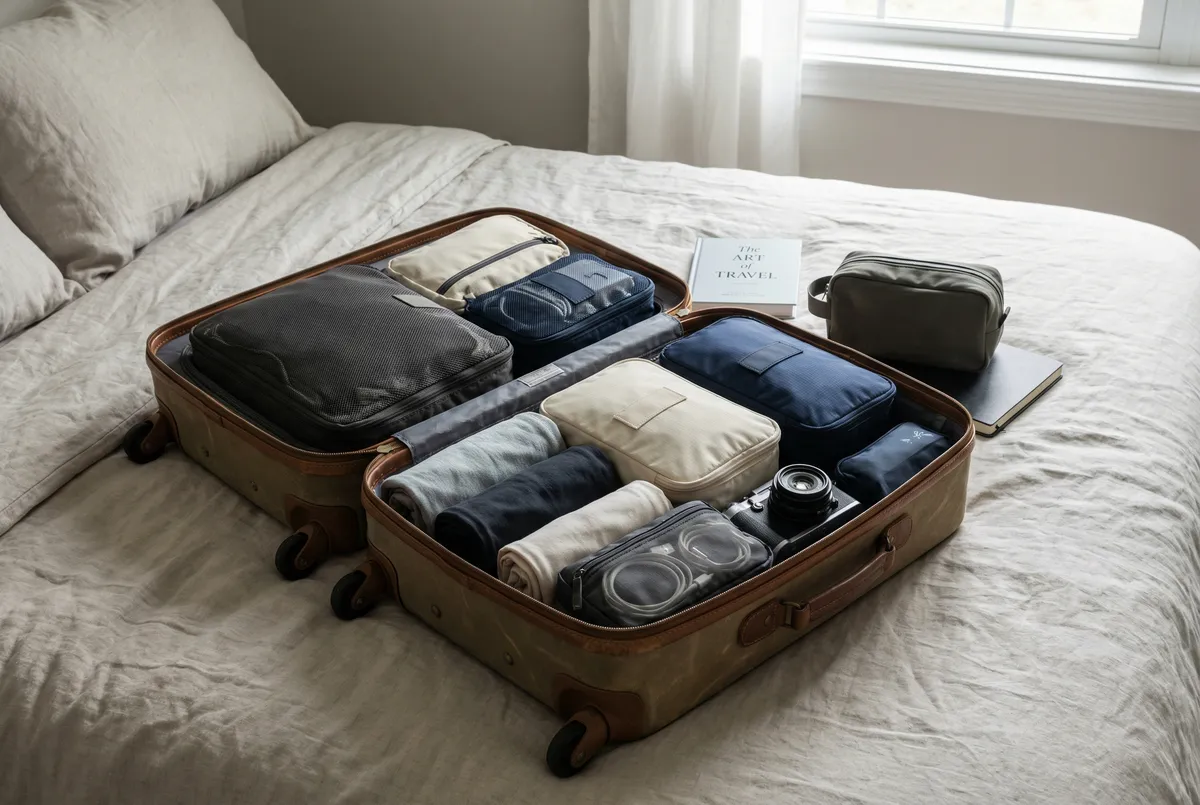
Regular packing cubes organize. Compression packing cubes organize and shrink. You pack clothes into the cube, zip it closed, then zip a second zipper that compresses everything down.
Compression cubes reduce clothing volume by 30-40%. That’s the difference between fitting 5 shirts or 7 shirts in the same space.
Building Your System
Use different cubes for different categories:
- Cube 1: Tops (shirts, blouses, sweaters)
- Cube 2: Bottoms (pants, shorts, skirts)
- Cube 3: Underwear and socks
- Cube 4: Dirty clothes (bring one empty)
This system means you never dig through your entire suitcase looking for one item. You know exactly which cube contains what you need.
Roll, Don’t Fold
Inside each cube, roll your clothes instead of folding. Rolling prevents wrinkles and uses space more efficiently.
The exception: Dress shirts and anything wrinkle-prone. Fold these carefully and place them on top of everything else.
Rolling technique: Fold sleeves in, then roll from bottom to collar. This creates a compact cylinder that stacks neatly.
The Capsule Wardrobe Approach
The secret to packing light isn’t bringing less. It’s bringing items that work together in multiple combinations.
The Color Palette Rule
Pick 2-3 colors that all coordinate. Everything you pack should work with everything else.
Example palettes that work:
- Navy, white, and tan
- Black, gray, and white
- Blue, white, and cream
With a coordinated palette, every top pairs with every bottom. A 5-shirt, 3-pants combination creates 15 different outfits.
What fails: Packing a red shirt, green pants, purple sweater, and orange shorts. Nothing coordinates, so you need more items to create complete outfits.
The 5-4-3-2-1 Method
For a week-long trip, use this formula:
- 5 tops (mix of t-shirts, blouses, sweaters)
- 4 bottoms (2 pants, 1 shorts, 1 skirt or dress)
- 3 pairs of shoes (wear the bulkiest, pack 2)
- 2 accessories (scarf, hat, belt, jewelry)
- 1 jacket
This creates dozens of outfit combinations while keeping your bag manageable.
Wear Your Bulkiest Items
Your heaviest shoes, thickest jacket, and bulkiest pants should be worn during travel. This keeps them out of your suitcase and frees space for lighter items.
Wear your heaviest shoes and your bulkiest layer. The jacket goes on or carries over your arm.
The Shoe Problem Solved
Shoes are the enemy of efficient packing. They’re bulky, heavy, and take disproportionate space.
The Two-Pair Maximum
Bring two pairs maximum. Wear one, pack one.
Pair 1 (wear): Comfortable walking shoes that work for most activities. Sneakers, supportive sandals, or versatile boots.
Pair 2 (pack): Dressier option for dinners or nicer occasions. Still comfortable enough to walk in.
What you don’t need: Flip-flops for the pool, running shoes for hypothetical workouts, fancy heels just in case, hiking boots if you didn’t plan to hike.
Shoe Packing Tricks
Stuff them: Fill shoes with socks, underwear, or small items. This uses empty space inside and helps shoes keep their shape.
Use shoe bags: Keeps dirt off your clothes. Cloth bags work better than plastic because they’re more flexible.
Place strategically: Put shoes at the bottom of your suitcase (the wheel end). This keeps the bag balanced and prevents shoes from crushing other items.
The shower cap hack: Put shoe covers over shoe bottoms to keep them from dirtying your clothes.
Toiletries Without the Bulk
Full-size toiletries are space killers. A standard shampoo bottle takes up as much room as three shirts.
What Hotels Actually Provide
Most hotels provide: Shampoo, conditioner, body wash, lotion, and soap. If you’re staying in hotels, you don’t need to pack these basics.
What you actually need to pack:
- Face wash and moisturizer
- Toothpaste and toothbrush
- Deodorant
- Any prescription medications
- Sunscreen
- Any specialized skincare products you can’t live without
That’s the essential list. Everything else is optional.
Travel-Size Containers
Transfer products into small containers. The 3-ounce TSA limit is actually plenty for a week.
Magnetic containers: These snap together, so you’re not digging through a toiletry bag for one specific bottle. They’re leakproof, which matters when shampoo explosions ruin your clothes.
Solid alternatives: Shampoo bars, solid perfume, bar soap. These don’t count toward your liquid limit and take up minimal space.
Use a clear hanging toiletry bag. It hangs on the bathroom door at your destination, keeping your items visible and accessible.
The Pre-Packed Toiletry Kit
Keep a dedicated toiletry kit that stays packed between trips. When you travel, grab it and go. This prevents the “did I pack my toothbrush” panic and ensures you never forget essentials.
Check expiration dates and replace used items before your next adventure.
Strategic Clothing Choices
Not all clothes pack equally. Some items are space hogs. Others are packing champions.
Fabrics That Travel Well
Winners:
- Merino wool: Doesn’t wrinkle, doesn’t smell, regulates temperature, dries quickly
- Synthetic blends: Quick-drying, wrinkle-resistant, lightweight
- Linen: Breathable, packs small, wrinkles are part of the charm
- Rayon: Lightweight, packs small, washes easily
Losers:
- 100% cotton: Wrinkles easily, takes forever to dry when washed
- Heavy denim: Bulky, slow to dry
- Anything requiring ironing: Just say no
- Delicate fabrics: High maintenance and prone to damage
Multi-Purpose Items
The button-down shirt: Wear it alone, layer it over a t-shirt, tie it around your waist, use it as a beach cover-up. One item, five uses.
The versatile dress: Dress it up with jewelry and nice shoes or dress it down with sneakers and a denim jacket. Takes up less space than a separate top and bottom.
The packable jacket: Lightweight, water-resistant, rolls into its own pocket. Provides warmth without bulk.
The sarong: Beach cover-up, scarf, blanket, privacy sheet, changing room curtain. Takes up almost no space.
The Outfit Test
Before packing any item, ask yourself: “Can I wear this with at least three other things I’m bringing?”
If the answer is no, leave it home. Every item should earn its spot in your suitcase by working with multiple other pieces.
Maximizing Your Personal Item
Airlines allow one carry-on and one personal item. Most people waste their personal item on a tiny purse. Don’t make that mistake.
Use Your Personal Item Fully
Bring the largest bag that qualifies as a personal item. This is typically a backpack, tote, or large purse that fits under the seat.
What goes in your personal item:
- Laptop and electronics
- Toiletries (easy access for security)
- Change of clothes (in case your carry-on gets gate-checked)
- Bulky items that don’t fit well in your suitcase
- Books, snacks, and entertainment
- Anything you’ll need during the flight
The tote bag strategy: A large tote holds your smaller purse inside. At the airport, it’s your personal item. At your destination, use the smaller purse and leave the tote in your hotel room.
Packing Order Matters
How you pack is as important as what you pack.
The Bottom Layer
Start with shoes and heavy items at the bottom (the wheeled end). This keeps your bag balanced and prevents heavy items from crushing delicate ones.
The Middle Layer
Rolled clothes in packing cubes go here. Place heavier items, jeans, sweaters, toward the bottom. Lighter items, t-shirts, underwear, toward the top.
The Top Layer
Anything that wrinkles easily or that you’ll need first: dress shirts, toiletries, electronics, your boarding pass.
Fill the Gaps
Use socks, underwear, and small items to fill empty spaces. This prevents items from shifting during travel and maximizes every inch.
Avoiding Overweight Fees
Airlines are getting stricter about weight limits. Here’s how to stay under the limit.
The Weighing Strategy
Weigh your bag before leaving for the airport. A luggage scale (available for about $10) prevents unpleasant surprises at the check-in counter.
The bathroom scale method: Weigh yourself, then weigh yourself holding your bag. The difference is your bag’s weight.
Lightening the Load
Lighter shoes: Athletic shoes weigh less than leather boots. Consider this when choosing what to pack.
Minimize toiletries: Take only what you need for the trip duration, not a full supply.
Digital over physical: Replace guidebooks with apps. Replace physical books with an e-reader.
Leave the extras: Sample-size products are fine. Full-size anything is usually unnecessary.
The Two-Week Challenge
Ready to test your skills? Try the two-week carry-on challenge.
Week 1: Prepare
- Buy compression packing cubes
- Choose your color palette
- Start wearing your travel outfit around home to test comfort
Week 2: Pack
- Use the 5-4-3-2-1 method
- Roll everything
- Use cubes to organize
- Weigh your bag
Two weeks in a carry-on is entirely doable with the right system. Most travelers find they use fewer than half of what they packed.
After your trip, note what you used, what you didn’t, and what you wished you’d brought. Refine your list for next time.
Common Packing Mistakes
Mistake 1: Packing the Night Before
You’re tired, rushed, and you throw in everything just in case. Pack 2-3 days before your trip. This gives you time to reconsider items and remove things you don’t actually need.
Mistake 2: Bringing Just-in-Case Items
“Just in case it rains.” “Just in case we go somewhere fancy.” “Just in case I need a swimsuit.”
Most just-in-case scenarios never happen. And if they do, you can buy what you need at your destination.
Mistake 3: Packing for Every Possible Activity
You don’t need workout clothes, hiking gear, formal wear, and beach attire for a 4-day city trip. Pack for your planned activities, not hypothetical ones.
Mistake 4: Ignoring the Weather
Check the forecast before packing. If it’s going to be 75 and sunny all week, you don’t need three sweaters.
Mistake 5: Bringing Too Many Toiletries
You’re going to a city, not the wilderness. If you forget something, you can buy it. You don’t need to pack your entire bathroom.
The Laundry Solution
For trips longer than five days, plan to do laundry once. This lets you pack half as much.
Quick Sink Washing
Bring a small packet of detergent sheets (they’re flat and take up almost no space). Wash underwear, socks, and t-shirts in the hotel sink. Hang them to dry overnight.
What dries quickly: Synthetic fabrics, thin cotton, underwear, socks.
What doesn’t: Jeans, thick sweaters, anything 100% cotton.
Laundromat Strategy
Many cities have laundromats or wash-and-fold services. Spending $10-15 on laundry is cheaper than checking a bag.
Book accommodations with laundry facilities. Many Airbnbs and some hotels offer in-room washers and dryers.
Your First Carry-On Trip
If you’ve never traveled carry-on only, start with a short trip. A 3-4 day weekend is perfect for testing your packing skills without the pressure of a long vacation.
Start small: Pack for a weekend using the 5-4-3-2-1 method. See how it feels.
Add compression cubes: Try compression packing cubes and see how much more you can fit.
Implement the capsule wardrobe: Choose coordinated colors and see how many outfits you can create.
Go longer: Take a week-long trip with just a carry-on.
After one successful carry-on trip, you’ll never want to check a bag again.
The Real Secret
Efficient packing isn’t about cramming more stuff into your bag. It’s about bringing less stuff that works harder.
Most people fail because they pack for imaginary scenarios. They bring clothes for activities they won’t do, weather that won’t happen, and occasions that won’t arise.
You don’t need to sacrifice comfort or style. You need to be strategic about what you bring and how you pack it.
The goal isn’t the smallest possible bag. The goal is bringing exactly what you need, nothing you don’t, and having it all fit comfortably in a carry-on.
That’s achievable for anyone willing to think critically about their packing choices and use space efficiently.
Pack smart, travel light, and enjoy the freedom that comes with carrying everything you need on your own back.