Most productivity advice is garbage. You already know you should “wake up earlier” and “use a planner.” What you need are strategies that actually fit into your real life—the chaotic, interrupt-driven reality of modern work.
After testing dozens of approaches with readers and interviewing productivity researchers, I’ve found what actually moves the needle. These aren’t trendy hacks or influencer tips. They’re practical changes that transform how you work.
The Real Problem Isn’t Laziness
Here’s what most productivity articles get wrong: they assume your main problem is motivation. It’s not.
UC Irvine researchers found that after an interruption, it takes an average of 23 minutes to refocus on your original task. The average worker gets interrupted every 2 minutes. No amount of willpower solves that math.
Microsoft’s 2025 workplace report found some alarming numbers: 48% of employees feel their work is “chaotic and fragmented.” People average 117 emails per day. Twenty-nine percent still check work email after 10 PM. More than half don’t feel productive at work.
The solution isn’t trying harder. It’s redesigning your environment and habits so productivity happens automatically.
Time Management That Actually Works
The Energy-Based Scheduling Revolution
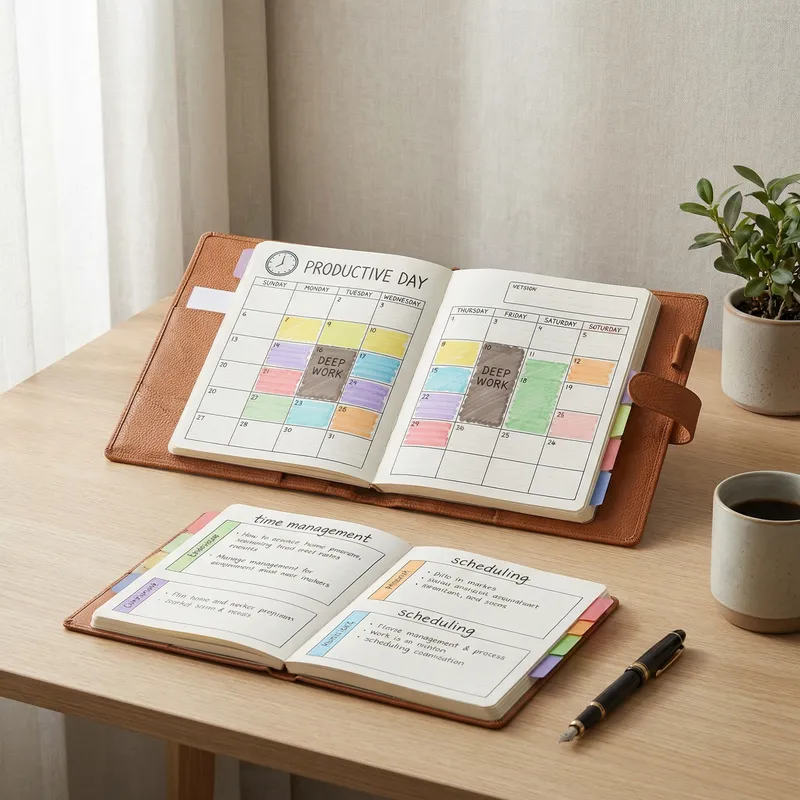
Stop scheduling by hour. Schedule by energy level.
Track your energy on a scale of 1-10 for one week, noting levels throughout each day. Most people’s patterns surprise them. The ” afternoon slump” isn’t universal—some people peak then, others crash. Your individual rhythm matters more than any generic advice.
Once you know your pattern, protect your peak hours ruthlessly. Save administrative tasks, email, and meetings for your energy troughs. A software developer I work with moved her coding to 9 AM-noon and moved all meetings to afternoons. Her output stayed the same in hours but doubled in value.
Cal Newport, Georgetown professor and author of “Deep Work,” advocates for a pre-work transition ritual. Before diving into focused work, do something that signals to your brain: “attention is about to change mode.” This might be a five-minute walk, making tea, or clearing your desk. The ritual acts like a warmup for your brain.
Timeboxing Beats Todo Lists
Todo lists lie to you. They pretend tasks have equal weight and ignore how long things actually take.
Timeboxing fixes this. When you block “10:00-11:30 write report” on your calendar, something shifts. Parkinson’s Law states that work expands to fill the time available. When you give yourself an hour for something that takes twenty minutes, it somehow takes an hour. Timeboxing in the other direction—giving yourself half the time you think you need—often reveals how much fat was in your original estimate.
Start with two timeblocked focus periods daily. Protect them like meetings with your most important client. Eventually, build up to three or four.
The “Eat That Frog” Method, Refined
Mark Twain famously said to eat a live frog first thing in the morning. The idea: do your hardest, most dreaded task first, when willpower is highest.
But here’s the nuance most people miss: it only works if you identify the right frog. For most knowledge workers, the frog isn’t one task—it’s starting. The first fifteen minutes of a difficult project feel harder than they actually are.
The real hack: commit to just five minutes. Tell yourself you’ll work on the hard thing for five minutes, then you can stop. Ninety percent of the time, you’ll keep going. The psychological barrier was the start, not the work itself.
Your Digital Environment Matters More Than You Think
Notification Bankruptcy
Every notification you allow is a small theft of attention. Apps compete for your focus with sophisticated psychological design. The red badge, the vibration, the “just checking” habit—these aren’t neutral.
The fix isn’t willpower. It’s architecture.
Turn off everything except actual emergencies. On iPhone, use Focus modes to create different profiles for work and personal time. On Android, Digital Wellbeing does similar work. The goal isn’t to become unreachable—it’s to batch your attention, not let others fragment it.
One reader told me she disabled all notifications for a month. “I thought I’d miss something important,” she said. “But nothing bad happened. My boss still reached me when it mattered. I just got eight hours back every week.”
Browser Tab Chaos
The average person has 70 browser tabs open. That’s not a productivity system—that’s a digital hoarding problem.
Use OneTab (free browser extension) to instantly consolidate tabs into a list. Reclaim those megabytes and the mental load of “I should read that sometime.” When you need a tab again, click to restore the whole list or individual ones.
For a more systematic approach, try the “three tabs max” rule. Only three pages open at any time: what you’re working on, a reference page, and a “parking lot” for stuff you need later. When you hit four, close something.
The Email Inbox Reset
Email isn’t your to-do list. Stop letting it drive your day.
Try the “touch it once” rule with a twist: if an email takes less than two minutes to handle, do it immediately. If it takes longer, calendar time to address it later, then archive or file the email. Never leave it sitting in your inbox to be “dealt with someday.”
Schedule three specific times daily for email: morning, after lunch, late afternoon. Outside those windows, don’t check. This single change alone can reclaim two-plus hours daily for most people.
AI as Your Productivity Partner
What AI Actually Helps With
In 2026, AI tools have matured enough to be genuinely useful—but only if you use them strategically.
Meeting summaries, first drafts, research synthesis, and administrative automation represent the areas where AI actually helps.
What AI Doesn’t Help With
AI can’t do your deep creative work. It can’t solve problems that require novel thinking. It can’t build relationships or lead teams.
The workers thriving in 2026 aren’t the ones using AI to replace thinking. They’re using AI to eliminate thinking about low-value tasks so they can focus on work that actually matters.
Avoiding Productivity Burnout
The “Enough” Problem
Productivity culture has a dark side. If you’re always optimizing, always improving, always “hacking”—when does it end?
The research is clear: constant productivity optimization leads to burnout. A 2025 study found that 75% of workers feel “sometimes” burned out, while 25% feel “often” or “always” burned out.
The antidote isn’t less productivity—it’s defining what “enough” looks like. What does a successful day actually require? Often, it’s far less than we pressure ourselves to achieve.
The Shutdown Ritual
Cal Newport advocates for a “shutdown ritual” at the end of each workday. Before you leave:
- Check your inbox one final time
- Review tomorrow’s calendar
- Write down any open loops so your brain stops cycling on them
- Say (literally say) “shutdown complete”
This prevents the weekend brain that keeps working even when you’re not. One reader told me this ritual alone ended her Sunday-night anxiety about Monday.
Strategic Rest Is Not Laziness
Rest isn’t the opposite of productivity—it’s a requirement for it.
Strategic rest means taking real breaks: walks, conversations, meals without screens. Not “scroll Twitter while pretending to rest.” Your brain needs genuine downtime to consolidate learning and reset attention.
Schedule rest like you schedule meetings. Protect it. Without recovery, you’re not productivity hacking—you’re just burning out faster.
Putting It All Together
You don’t need all of these strategies. Start with one that resonates and stick with it for three weeks until it becomes automatic.
The productivity hackers who succeed aren’t the ones doing the most—they’re the ones removing friction from what matters most.
Pick your frog: one change that fits your situation. Try it. Adjust. Move on.
That’s what actually works.
What productivity challenges are you facing? Share your experiences in the comments below.